http://www.thefabricator.com/article/tc/life-in-abstract/#
Life in abstract
Artist makes a living from two loves—art and welding
By Amanda Carlson
March 14, 2011
Artist mi Chelle Vara is one of the lucky ones. She has found a way to combine her two passions—art and welding—into a career and a business that she loves.
Artist and welder mi Chelle Vara stands next to “Pot’ ente” made of repurposed metal, galvanized and topcoated with hand-made paint.Does life imitate art or does art imitate life? Or, is it a little of both?
Neither one comes with instruction or ever seems well-defined. Just ask artist mi Chelle Vara. For instance, there was a time when Vara thought her life would be defined, at least partially, as an industrial welder. She went to school, earned certifications, trained as an underwater welder, and even worked for an MRI manufacturer as a TIG welder. But after realizing that working day in and day out within strict boundaries with a high routine factor just wasn't for her, she had to switch gears. It turns out that the variety she was able to achieve with her art was something she could no longer live without, and finally, she succumbed.
"Art really calls me, so much more than any other job. Art has a lot of difficult facets to it and it's always changing," Vara explained.
The good news for Vara was that she didn't have to choose between welding and art. Inside Vara's own Ballard Road Art Studio in Wilton, N.Y., is a business that allows her to be both welder and artist in the same breath. She and business partner Chad Wilson fabricate handrails, gates, functional artistic pieces like furniture, and sculptures.
Vara works closely with clients to design functional or sculpted pieces that encompass their personalities and blend into their own original space.
The first step is researching the space in which the piece will reside.
"I'll actually go to their yard and watch how the light rises and sets; how they'll view it from their house; and how the traffic will view it. We take everything into account. The site is very important because it changes throughout the day."
Evoking a Feeling
Sculpture—where conceptual design meets reality—is where Vara is most content. Using MIG, TIG, an ironworker, milling machine, and a lathe, just to name a few, Vara marries the client's concept to the material and begins manipulating and joining pieces together to form the finished product.
Wilson chimes in on facets such as the installation process by considering weight and trajectory and deciding how best to perform the installation safely and securely.
Vara met Wilson outside of his own fabrication shop and the two struck up a quick professional partnership—each one volunteering time to help the other at his or her shop. In the mid-2000s, Wilson closed his shop and joined Vara at hers full-time.
"He does the very meticulous research and he's very detailed with aesthetic things. For instance, he'll pick out a bolt that stands out because it's not a matching color. Little details like that are really important. Sometimes I'm on a deadline and I'm not seeing that one bolt, so it's good to have another pair of eyes. He also organizes the cranes, he organizes putting the sculpture on the truck and getting it off the truck, and other things that I don't even think of."
Most of Vara's work is heavily veiled in abstract elements. Take her flatwear creations (see Figure 1) or the twisted I-beam she named "Life" (see Figure 2). Each sculpture's shape and lines allow the viewer to use his imagination and decide for himself what's in front of him and how it makes him feel.
Vara believes no one should be spoon-fed anything, including how to interpret art. "Let's face it, the universe has gotten really lazy. I believe that an onlooker should interact with the work. Their interaction, at that point, should be their own thought. If they are emotionally engaged, then I've done my job. I want to evoke in people a feeling—whether it is good, bad, or indifferent."
On top of being an accomplished welder and metal sculptor, Vara also is a talented painter. Still, she added, there's nothing quite like working in three dimensions. It offers the artist an outlet for expression that is simply not possible in two-dimensional work. But when push comes to shove, for Vara, it's all about one thing.
"The welding is my favorite part because I get to go into my mute space and just create."
mi Chelle Vara, 6 Ballard Road, Wilton, NY 12831, 518-744-1664 www.mvarametalandpaint.com
Additional Information
--------------------------------------------------------------------------------
Amanda Carlson
Associate Editor
FMA Communications Inc.
833 Featherstone Road
Rockford, IL 61107
Phone: 815-227-8260
Saturday, March 19, 2011
Tuesday, February 22, 2011

Sunday, February 13, 2011
Exploring Gray
Funny- The color of weather influenced my direction as an artist at this time.
My style is normally very colorful but in this time I have explored the grays brought on by February. The white in color has stimulated 8 new painting. My first thought of exploring the interiors of expression using little or no color was that it would be confining and limited to me. But quite the opposite happened I found it freeing and intoxicating. I started and I didn’t want to stop.


My style is normally very colorful but in this time I have explored the grays brought on by February. The white in color has stimulated 8 new painting. My first thought of exploring the interiors of expression using little or no color was that it would be confining and limited to me. But quite the opposite happened I found it freeing and intoxicating. I started and I didn’t want to stop.


So you painters a fun thing to try is pick a color and stay within its values.
Thanks!

Thursday, January 20, 2011
Tony Magar
Chula Speaks Blog
News and commentary from Rick Romancito, arts and entertainment editor of The Taos News
http://chulaspeaks.blogspot.com/2006/02/tony-magar-energized.html
http://photos1.blogger.com/blogger/2979/1931/1600/magar2.jpg

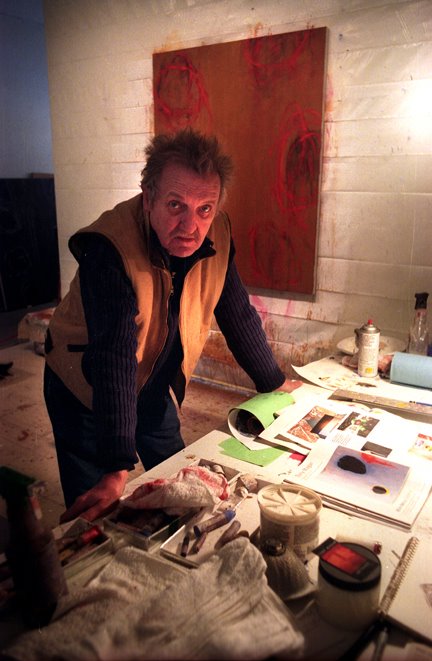
Tony Magar in his Taos studio. Photograph by Rick Romancito
No, your kid can’t do better.
Not unless they’ve become immersed in the world and creation of serious art and worked for years understanding its complexities. In short, making art is not an easy process. It is work, just as hard and torturous as digging a ditch, peeling latillas or sitting through legislative budget committees.
And being a serious artist doesn’t necessarily mean making beaucoup bucks through online marketing or corporate sponsorship. The yardstick for success isn’t straight line level in the art biz. It’s more like a tumbleweed, branching out sharp all which-way, only to get stuck under a Lexus zooming like a bat out of Vegas, with the driver wondering aloud “What’s burning?”
Which is one of the reasons an artist like Tony Magar might still be considered slightly eccentric. He is serious about art. And that’s why he lives in Taos.
Magar is back from New York City, where he was feted with an exhibition titled “The Absentee Universe” (Oct. 20-Nov. 26, 2005) at the Mike Weiss Gallery. It was a blast, he said, being back in that tilt-a-whirl madness and high end thrill-a-minute cool.
“It was right in Chelsea,” he said in his studio off Gusdorf Road in Taos, “and it was a good time to show there. It was a very active time to go there. I lucked out. In terms of the time and the kind of reaction from the people. I was happy to see a lot of old art comrades.”
He said all his peers from back in the day came to the opening, “which was nice.” Through the door there were folks like sculptor Mark Di Suvero who came, “and (painter) Ed Moses came and (sculptor) John Chamberlain was around the block having his show at the same time. So, I got to see him. A lot of artists I know came to the show. It was wonderful. I couldn’t have wished for anything better. To get that input, you know, from what they were doing and what I was doing, so there was a wonderful kind of exchange going on there. So, I really liked that a lot and it was worth going just for that.”
Part of the reason for going was to kind of feel out the possibility of moving back, he said, “but a week there was enough to convince me that I didn’t want to be there. Just so much action all the time, constantly, in terms of living, just surviving, getting through the day. There’s so much stuff. I mean, we crammed a lot of stuff in ... All these events are constantly happening every day, it seems like. A lot of interesting theater stuff, and, of course, you’ve got your restaurants. People to meet. It goes on and on. I would imagine that if I lived there it would settle down a bit. You know, one toys with the idea of moving back, but then after a week I was so happy to get back here, so I could reach some level of sanity.”
The show was a success and Magar got some high profile notice in The Village Voice and a possible upcoming piece in Art in America. But it was back in Taos, where you can hear yourself think, that some of that energy was transformed into creativity. “In terms of the work,” he said, “it took a leap forward. So, I was relating to that more than anything else. It got seen, and that was the jackpot. It got seen by people there and they all were very favorable towards it ... So, I came back full of energy and got to work again. The whole thing got energized.”
In an exhibit catalog put together for the Mike Weiss show, critic Michaël Amy wrote: “One drifts effortlessly into Tony Magar’s new abstract paintings, for these works suggest fluid, open spaces — ethers where things are in a state of perpetual flux. The nature of these fictive spaces is not instantly apparent however, for cursive looking discloses surfaces that at first seem opaque. Prolonged contemplation is infinitely more rewarding, for only then do the top glazes of oil reveal themselves to be translucent, disclosing layer after layer of paint — often of a different tone or color — buried underneath them. What results, is immeasurable pictorial depth.”
And there is a tactile sense of the work, that physical evidence of a constant series of decisions, ideas pushing and pulling across the surface that is only glimpsed when seen from afar. Up close, it becomes more dense and layered. You wonder: What was he thinking?
“I think one needs a certain amount of peace to create,” Magar said, “to have one’s own thoughts about your relationship to nature is totally changed immediately. You’re not wandering along looking at the beautiful blue sky and the mountains anymore. You’re trying to avoid people all day long.”
But somebody like Magar needs that fix every once in a while. “It opens you up to where your work could go, could develop and move on a little bit from where I was. But, that’s a process you have to work through.”
In a sense, he also needs that input here in Taos, where the comrades are fast disappearing over the horizon. London-born Magar used to rely on major dudes like the late great Bill Gersh and that whole posse of artists who made the 70s and 80s here a fury of activity to just talk and put the pedal to the metal.
Magar put down his thoughts on the subject to paper, calling it “Search and Destroy”:
“My friend Bill Gersh was having problems with his painting. So, I went to visit him. I could tell he was having conflicting thoughts about the paintings he was working on. We were sitting there in the studio, both eyeing what was left in the jug of wine, then, Bam!, he jumps up and grabs a coffee can of paint and hurls it at the canvas. At that moment, the destruction of the old had broken the stalemate. So, I left him with the rest of the wine. Now, he could move on and work with it.
“On the way back to town, I realized there’s a thin line between the ego and what the painting demands — to become a painting again demands passion to move on. This thought stayed with me a long time. What stops us from getting to the next layer? Fear. Or maybe the ego. The ego craves gratification. The ego demands satisfaction. The ego wants a safety net. The ego usually will settle for less. Like a bubble we’re stuck in. It stops us from moving on. I think it’s important for us as artists to watch and observe for breakthroughs in art and ourselves.
“The most exciting part of making art, for me, now, is the process of making and re-making. By that I mean not settling for the first draft.”
It may be somewhat dangerous to say so, even at this point in time (he’ll be 70 this year), but Magar said he doesn’t possess as much fear anymore. “It takes fearlessness to create — the see the new,” Magar continues in his statement, “for Gersh, for Pollack, for Basquiat. That’s the nature of the beast.”
The universe is constantly in a process of creation and destruction, integrated, he said, toward “becoming.” And, at the end of the day, “ we are all just stardust.”
Magar is still moving on and is not about to settle for anything less.
posted by coyoteboy at 8:47 AM
2 Comments:
Anonymous said...
Magar--the most underrated artist in America--a visionary
7:42 AM
Anonymous said...
Magar is a genius, one of the last of the brilliant artists from the American abstract movement.
11:55 AM
News and commentary from Rick Romancito, arts and entertainment editor of The Taos News
http://chulaspeaks.blogspot.com/2006/02/tony-magar-energized.html
http://photos1.blogger.com/blogger/2979/1931/1600/magar2.jpg

Tony Magar: Energized
Tony Magar in his Taos studio. Photograph by Rick Romancito
No, your kid can’t do better.
Not unless they’ve become immersed in the world and creation of serious art and worked for years understanding its complexities. In short, making art is not an easy process. It is work, just as hard and torturous as digging a ditch, peeling latillas or sitting through legislative budget committees.
And being a serious artist doesn’t necessarily mean making beaucoup bucks through online marketing or corporate sponsorship. The yardstick for success isn’t straight line level in the art biz. It’s more like a tumbleweed, branching out sharp all which-way, only to get stuck under a Lexus zooming like a bat out of Vegas, with the driver wondering aloud “What’s burning?”
Which is one of the reasons an artist like Tony Magar might still be considered slightly eccentric. He is serious about art. And that’s why he lives in Taos.
Magar is back from New York City, where he was feted with an exhibition titled “The Absentee Universe” (Oct. 20-Nov. 26, 2005) at the Mike Weiss Gallery. It was a blast, he said, being back in that tilt-a-whirl madness and high end thrill-a-minute cool.
“It was right in Chelsea,” he said in his studio off Gusdorf Road in Taos, “and it was a good time to show there. It was a very active time to go there. I lucked out. In terms of the time and the kind of reaction from the people. I was happy to see a lot of old art comrades.”
He said all his peers from back in the day came to the opening, “which was nice.” Through the door there were folks like sculptor Mark Di Suvero who came, “and (painter) Ed Moses came and (sculptor) John Chamberlain was around the block having his show at the same time. So, I got to see him. A lot of artists I know came to the show. It was wonderful. I couldn’t have wished for anything better. To get that input, you know, from what they were doing and what I was doing, so there was a wonderful kind of exchange going on there. So, I really liked that a lot and it was worth going just for that.”
Part of the reason for going was to kind of feel out the possibility of moving back, he said, “but a week there was enough to convince me that I didn’t want to be there. Just so much action all the time, constantly, in terms of living, just surviving, getting through the day. There’s so much stuff. I mean, we crammed a lot of stuff in ... All these events are constantly happening every day, it seems like. A lot of interesting theater stuff, and, of course, you’ve got your restaurants. People to meet. It goes on and on. I would imagine that if I lived there it would settle down a bit. You know, one toys with the idea of moving back, but then after a week I was so happy to get back here, so I could reach some level of sanity.”
The show was a success and Magar got some high profile notice in The Village Voice and a possible upcoming piece in Art in America. But it was back in Taos, where you can hear yourself think, that some of that energy was transformed into creativity. “In terms of the work,” he said, “it took a leap forward. So, I was relating to that more than anything else. It got seen, and that was the jackpot. It got seen by people there and they all were very favorable towards it ... So, I came back full of energy and got to work again. The whole thing got energized.”
In an exhibit catalog put together for the Mike Weiss show, critic Michaël Amy wrote: “One drifts effortlessly into Tony Magar’s new abstract paintings, for these works suggest fluid, open spaces — ethers where things are in a state of perpetual flux. The nature of these fictive spaces is not instantly apparent however, for cursive looking discloses surfaces that at first seem opaque. Prolonged contemplation is infinitely more rewarding, for only then do the top glazes of oil reveal themselves to be translucent, disclosing layer after layer of paint — often of a different tone or color — buried underneath them. What results, is immeasurable pictorial depth.”
And there is a tactile sense of the work, that physical evidence of a constant series of decisions, ideas pushing and pulling across the surface that is only glimpsed when seen from afar. Up close, it becomes more dense and layered. You wonder: What was he thinking?
“I think one needs a certain amount of peace to create,” Magar said, “to have one’s own thoughts about your relationship to nature is totally changed immediately. You’re not wandering along looking at the beautiful blue sky and the mountains anymore. You’re trying to avoid people all day long.”
But somebody like Magar needs that fix every once in a while. “It opens you up to where your work could go, could develop and move on a little bit from where I was. But, that’s a process you have to work through.”
In a sense, he also needs that input here in Taos, where the comrades are fast disappearing over the horizon. London-born Magar used to rely on major dudes like the late great Bill Gersh and that whole posse of artists who made the 70s and 80s here a fury of activity to just talk and put the pedal to the metal.
Magar put down his thoughts on the subject to paper, calling it “Search and Destroy”:
“My friend Bill Gersh was having problems with his painting. So, I went to visit him. I could tell he was having conflicting thoughts about the paintings he was working on. We were sitting there in the studio, both eyeing what was left in the jug of wine, then, Bam!, he jumps up and grabs a coffee can of paint and hurls it at the canvas. At that moment, the destruction of the old had broken the stalemate. So, I left him with the rest of the wine. Now, he could move on and work with it.
“On the way back to town, I realized there’s a thin line between the ego and what the painting demands — to become a painting again demands passion to move on. This thought stayed with me a long time. What stops us from getting to the next layer? Fear. Or maybe the ego. The ego craves gratification. The ego demands satisfaction. The ego wants a safety net. The ego usually will settle for less. Like a bubble we’re stuck in. It stops us from moving on. I think it’s important for us as artists to watch and observe for breakthroughs in art and ourselves.
“The most exciting part of making art, for me, now, is the process of making and re-making. By that I mean not settling for the first draft.”
It may be somewhat dangerous to say so, even at this point in time (he’ll be 70 this year), but Magar said he doesn’t possess as much fear anymore. “It takes fearlessness to create — the see the new,” Magar continues in his statement, “for Gersh, for Pollack, for Basquiat. That’s the nature of the beast.”
The universe is constantly in a process of creation and destruction, integrated, he said, toward “becoming.” And, at the end of the day, “ we are all just stardust.”
Magar is still moving on and is not about to settle for anything less.
posted by coyoteboy at 8:47 AM
2 Comments:
Anonymous said...
Magar--the most underrated artist in America--a visionary
7:42 AM
Anonymous said...
Magar is a genius, one of the last of the brilliant artists from the American abstract movement.
11:55 AM
Tuesday, January 11, 2011

Thursday, January 6, 2011

Saturday, December 18, 2010
Wishing everyone a Happy Holidays!
Happy Holidays!
Thank you all for your support, ideas, time, and friendship.
I look forward to sharing in another exceptional year, of art, fun and prosperity.
Happy New Year!
Peace to all-!

Thank you all for your support, ideas, time, and friendship.
I look forward to sharing in another exceptional year, of art, fun and prosperity.
Happy New Year!
Peace to all-!

Subscribe to:
Posts (Atom)